
What Triggers an ADI Standards Check?
Understand how the DVSA uses pupil test data, pass rates, serious faults and examiner interventions to monitor instructor performance.
The DVSA looks for patterns, not one poor test result
The Driver and Vehicle Standards Agency monitors Approved Driving Instructor performance using pupil practical-test results collected over a rolling 12-month period.
The system is designed to identify repeated patterns that may suggest weaknesses in pupil preparation, teaching, risk management or instructional standards.
The best driving instructors continue reviewing, adapting and improving their teaching.
Your ADI badge connects pupil tests to your record
When your ADI badge is displayed during a pupil’s practical driving test, the result contributes to your performance data.
Results from different test centres are combined and continually updated. Older tests leave the rolling 12-month period as new test results are added.
- The trigger indicators normally apply once five or more pupil tests are recorded during the 12-month period.
- Instructors with fewer than five recorded tests can still be asked to complete a Standards Check during their registration.
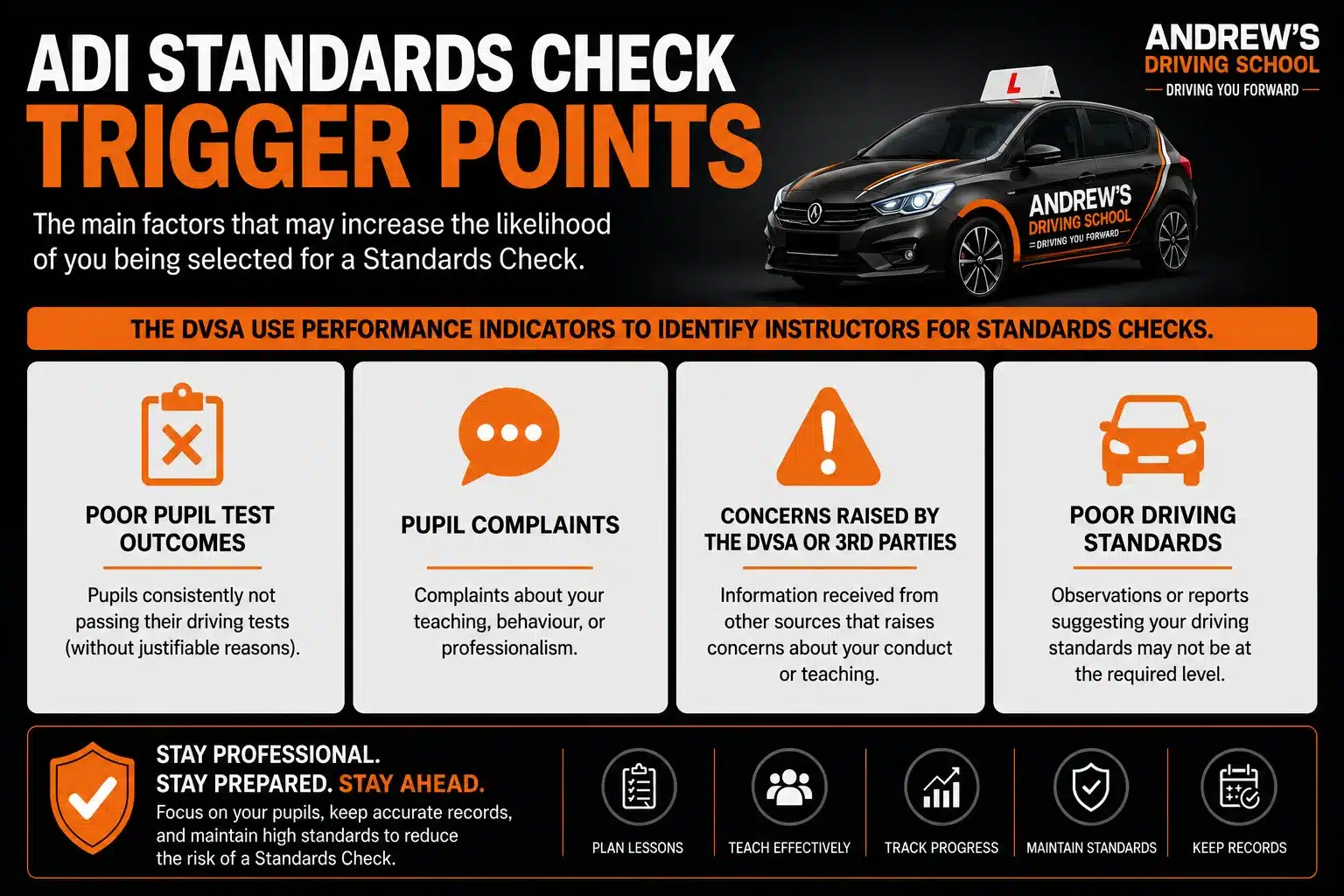
The main warning signs monitored by the DVSA
A trigger point is not automatically a failure. It is an indicator that pupil test results may require closer attention.
- High average driving faults
- High average serious faults
- Examiner safety interventions
- Low overall pupil pass rate
ADI Standards Check trigger thresholds
Each category is measured separately. Reaching three or more thresholds can make a Standards Check request more likely.
Average Driving Faults
This measures the average number of driving faults recorded across your pupils’ practical tests.
140 driving faults across 20 tests produces an average of seven faults per test.
Average Serious Faults
This monitors serious or dangerous faults that result in an automatic practical-test failure.
12 serious faults across 20 tests produces an average of 0.6 serious faults per test.
Physical Safety Interventions
This measures tests where the examiner physically intervened using the steering wheel or dual controls to prevent danger.
Three examiner interventions across 30 tests produces an intervention rate of 10%.
Overall Pupil Pass Rate
A consistently low pass rate may indicate that pupils are being presented for test before they are fully ready.
Eight passes from 20 tests produces an overall pass rate of 40%.
Reaching three or more thresholds raises the risk
One or two indicators do not normally result in an immediate Standards Check request. Reaching three or more of the monitored thresholds can make a request considerably more likely.
Generally unlikely to lead to an immediate check.
Still unlikely in many circumstances.
A Standards Check becomes considerably more likely.
The DVSA can still request a Standards Check
Trigger thresholds are used to prioritise instructors, but the DVSA can request a Standards Check during any four-year ADI registration period.
The assessment examines how effectively you teach during a normal client-centred lesson rather than how well you perform a rehearsed demonstration.
The three Standards Check competencies
Lesson Planning
A structured lesson that reflects the pupil’s ability, needs and agreed learning goals.
Risk Management
Safe instruction, appropriate intervention and effective management of developing hazards.
Teaching and Learning
Client-centred communication, suitable coaching and evidence that meaningful learning is taking place.
The strongest Standards Check lesson normally reflects your genuine everyday teaching rather than a scripted or staged performance.
Monitor your results and review your teaching
Regular self-review can help identify repeated faults, weak pupil preparation and areas where your teaching approach may need to change.
- Track pupil test outcomes
- Review repeated serious faults
- Analyse examiner interventions
- Reflect on pupil readiness
- Seek training before your Standards Check
ADI Standards Check FAQs
What is a Standards Check trigger point?
A trigger point is a performance threshold used by the DVSA to identify instructors whose pupil test data may require closer review.
Which results are monitored?
The main indicators are average driving faults, average serious faults, examiner interventions and overall pupil pass rate.
Will one bad test result trigger a check?
Not normally. The DVSA reviews patterns across pupil tests during a rolling 12-month period rather than relying on one isolated result.
Can I be called for a Standards Check without reaching a threshold?
Yes. The DVSA can request a Standards Check during your registration period even where the main data indicators have not been reached.
What should I do if my figures are close to a trigger?
Review your pupil test results, identify repeated weaknesses and consider professional Standards Check training before concerns develop further.
Training, guidance and official information
Standards Check Coaching
Explore professional support and practical assessment preparation.
View training → FranchiseJoin Andrew’s Driving School
Find out about instructor support, CPD and Standards Check training.
Explore the franchise → Instructor resourcesInstructor Zone
Browse instructor training, development and business resources.
Visit the Instructor Zone →Prepare before the DVSA contacts you
Book a professional Standards Check assessment and receive practical guidance based on your current teaching.