Stopping Distances Chart, Calculator & Quiz
Learn the official Highway Code distances, use the calculator, and test your knowledge before your theory test.
What does stopping distance mean?
Stopping distance is the total distance your vehicle travels from the instant you notice a hazard to the moment the car comes to a complete stop. It consists of two parts:
- Thinking distance: How far you travel while your brain clocks the danger and your foot moves to the brake.
- Braking distance: How far you travel after the brakes are applied until the car stops.
Theory Test Guide: Stopping Distance
You don't need to memorise every number in the Highway Code. Use the Multiply Method: Start at 2 (for 20mph) and add 0.5 for every 10mph increase.
Multiplier Table
| Speed | Multiplier | Total |
|---|---|---|
| 20 mph | x 2 | 40 ft |
| 30 mph | x 2.5 | 75 ft |
| 40 mph | x 3 | 120 ft |
| 50 mph | x 3.5 | 175 ft |
| 60 mph | x 4 | 240 ft |
| 70 mph | x 4.5 | 315 ft |
Hazardous Conditions
🌧️ Wet Roads
Stopping distance DOUBLES because tyres struggle to grip the road surface.
Distance x 2❄️ Ice & Snow
Stopping distance can be up to 10 TIMES longer. Maintain massive gaps!
Distance x 10⏱️ 2-Second Rule
Keep a safe gap. If the road is wet, increase this to 4 seconds; if icy, up to 20 seconds.
"Only a fool breaks the rule"Stopping Distance Calculator
Use our interactive online stopping distance calculator to see how different speeds impact your safety on the road.
Calculate Your Distance
Enter your speed to see the math in action:
Why
Understanding
Stopping
Distances
Matters
Knowing how stopping distances increase with speed is essential for safe driving. At 30 mph, the stopping distance is about 75 feet, but at 40 mph, it jumps by 45 feet—a rise of over 50%.
At 70 mph, you may need the length of a football field to stop, even in ideal conditions. In wet weather, that distance can more than double. Thinking distance—the distance your car travels before you even react—is equal to your speed in feet. That means at 40 mph, you’ve already travelled 40 feet before braking. Always leave a 2-second gap, or 4 seconds in the wet.
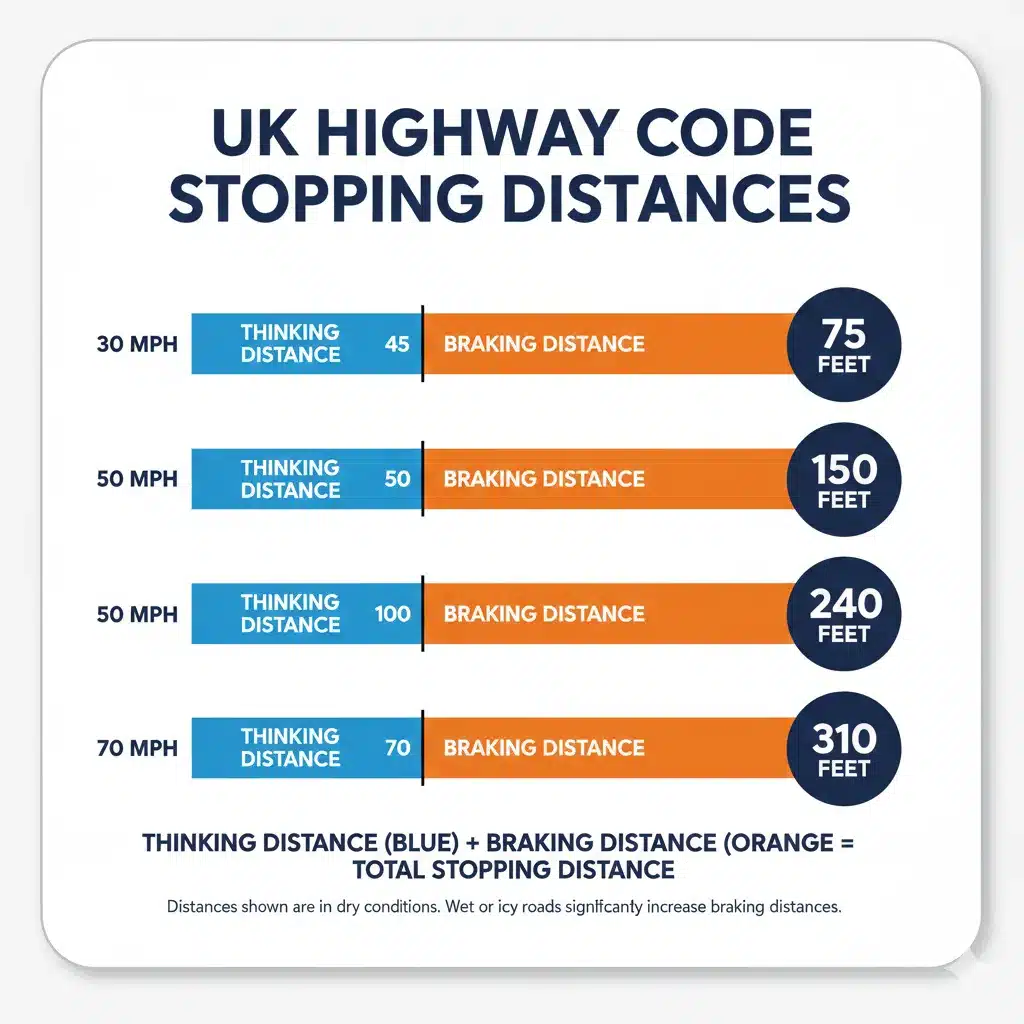
Diagram: Thinking distance (Blue) + Braking distance (Red) = Total Stopping Distance.
The 2 Second Rule
One of the key principles for safe driving is the 2 second rule, which helps maintain safe distances on the road. In dry conditions, it is important to keep at least a 2 second gap between your vehicle and the one ahead.
"Watch when the car in front passes a fixed object, like a lamppost... mentally say 'only a fool breaks the 2 second rule' until you reach that object."
In heavy rain, repeat the phrase to create a 4 second cushion. In icy conditions, aim for a much larger gap of about 20 seconds.
Can You Score 5/5 on Stopping Distances?
Take this quick knowledge test to check your theory test understanding.
Open the Stopping Distances Knowledge Test
Stopping Distances Knowledge Test
Use this quick learner driver quiz to revise Highway Code stopping distances, thinking distance, braking distance, the 2-second rule, and wet weather driving safety before your theory test.
Answers and Explanations
- 23 metres. At 30 mph, total stopping distance is 23 metres in dry conditions.
- Doubles. Wet roads reduce tyre grip and increase braking distance.
- Thinking distance and braking distance. Total stopping distance is the sum of both.
- 2 seconds. In dry conditions, use the 2-second rule for a safe following distance.
- Up to 10 times as long. Ice and snow can massively increase stopping distance.
Stopping Distance FAQs
Stopping distance is the total distance your vehicle travels from the moment you notice a hazard until the car comes to a complete stop. It is made up of thinking distance and braking distance.
At 30 mph, the typical stopping distance is 23 metres. This includes 9 metres of thinking distance and 14 metres of braking distance.
Stopping distance can be affected by several factors including:
- your speed
- driver reaction time
- weather conditions
- road surface
- tyre condition
- brake performance
- visibility
In wet conditions, stopping distance can double. Reduced tyre grip means the vehicle takes much longer to slow down safely.
On icy or snowy roads, stopping distances can be up to 10 times longer than in dry conditions.
Thinking distance is the distance travelled during the time it takes you to notice a hazard and react by pressing the brake pedal.
Braking distance is the distance travelled after you apply the brakes until the car comes to a complete stop.
The 2 second rule is a safe following distance guide. In dry conditions, keep at least 2 seconds behind the vehicle in front. Increase this to 4 seconds in rain and much more in ice or snow.
Discover more learner driver guides, driving test tips, manoeuvres, and lesson recaps to help you build confidence and pass your test. Visit the Learner Hub